

↑ NAVAL AIR FACILITY ATSUGI, Japan (March 21, 2011) U.S. Navy Sailors and U.S. Marine Corps Marines test dependants for radiation exposure. NAF Atsugi dependants have begun an authorized voluntary departure back to the United States. (U.S. Navy video by Mass Communication Specialist 2nd Class Bryan Reckard/Released)
Back on 3/21/2011, the aircraft carrier USS George Washington departed Commander, Fleet Activities Yokosuka though it was under repairs.
Potassium iodide pills were distributed to sailors and families remaining at the naval base and at the Atsugi Naval Air Facility. (*1)
Capt. Kenneth Reynard commented, “As conditions at the Fukushima Dai-ichi plant deteriorated, it was crucial that we brought the skilled workers along with us to sea.” (*2)
It was supposed to be “precautionary measure”, however, the plant parameter is suggesting an intriguing possibility that something -unreported officially- happened in reactor3 in the early morning of the day.
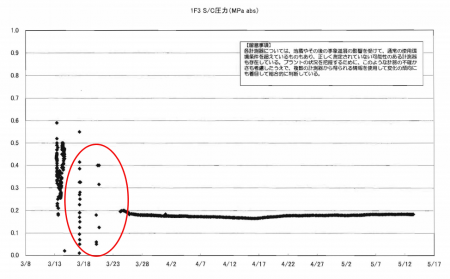
On 6/13/2011, Tepco revised and published the data about the plant situation just after 311. The part surrounded by the red line shows the reactor pressure (System A) jumped up to 123,100 times much as before from 1:25 to 2:30 AM of 3/21/2011. (*3)

Each charts also show the spiking of plant parameter on 3/21/2011. (*4)
↓ The reactor pressure (System A, MPa)

↓ The pressure of D/W (PCV)

↓ The pressure of S/C (PCV)
Around 15:55 of 3/21/2011, black smoke was seen coming up from reactor3. (*5)

Also from 3/20 to 3/23, CTBT, Comprehensive Nuclear-Test-Ban Treaty’s radiation monitoring post at Takasaki Gunma recorded the huge leap of measurements of various nuclides. (*6)

About the black smoke, IRSN stated there’s a possibility it’s from the chemical reaction of heating corium touched the concrete base of PCV by 3/26/2011. (*7)
*1 http://www.cbsnews.com/8300-503543_162-503543.html?keyword=fukushima+daiichi
*2 http://www.navy.mil/submit/display.asp?story_id=59279
*3 http://www.tepco.co.jp/nu/fukushima-np/plant-data/f1_8_Parameter_data.pdf
*4 http://www.tepco.co.jp/nu/fukushima-np/plant-data/f1_8_Parameter_graph_20110613teisei.pdf
*5 http://www.youtube.com/watch?v=VOuv58C-f3U
*6 http://www.cpdnp.jp/pdf/120227Takasaki_report_Feb22.pdf
*7 http://www.afpbb.com/article/disaster-accidents-crime/disaster/2792610/7005562
Iori Mochizuki
_____
Français :
21 mars 2011 – Le jour où le G.Washington a évacué Yokosuka il y a sans doute eu une explosion faisant fondre le béton de la PCV dans le réacteur 3
↑ NAVAL AIR FACILITY ATSUGI, Japon (21 mars 2011) – Marins de l’U.S. Navy et marines de l’U.S. Marine Corps testant la radioactivité des dépendances. Les affectés à la NAF Atsugi ont commencé une évacuation volontaire autorisée vers les États Unis. (vidéo de l’U.S. Navy par le spécialiste de la Communication de masse, le 2e Classe Bryan Reckard/Publié)
Retour sur le 21 mars 2011, le porte-avion USS George Washington a quitté le centre de commande des activités de la flotte de Yokosuka bien qu’il soit en réparation.
Des pastilles d’iodure de potassium ont été distribuées aux marins et à leurs familles restant sur la base navale et dans la Naval Air Facility d’Atsugi. (*1)
Le Capt. Kenneth Reynard raconte : “Comme les conditions se détérioraient à la centrale nucléaire de Fukushima Dai-ichi, il était crucial que nous emmenions avec nous en mer les travailleurs spécialisés .” (*2)
C’était supposé être une “mesure de précaution”, toutefois, les paramètres usine suggèrent une intrigante possibilité que quelque chose -non officiellement rapportée – s’est passé dans le réacteur 3 au tout début de la matinée ce jour-là.
Le 13 juin 2011, Tepco a revu et publié les données de la situation de la centrale juste après le 11-3. La partie encadrée en rouge indique que la pression du réacteur (System A) est montée à 123 100 fois celle d’avant, entre 01:25 et 02:30 ce 21 mars 2011. (*3)
Tous ces graphiques montrent aussi le pic des paramètres usine le 21 mars 2011. (*4)
↓ La pression du réacteur (System A, en MPa)
↓ La pression des enceintes sèche et humide (D/W) dans la PCV (= enceinte de confinement primaire)
↓ La pression du S/C (PCV)
Vers 15:55 ce 21 mars 2011, une fumée noire était vue sortant du réacteur 3. (*5)
En outre, du 20 au 23 mars 2011, la borne CTBT, (Comprehensive Nuclear-Test-Ban Treaty) de contrôle de la radioactivité à Takasaki dans Gunma a enregistré d’énormes hausses dans les mesures de divers nucléides. (*6)
Concernant la fumée noire, l’IRSN a affirmé qu’il soit possible que ce fut une réaction chimique lorsque le corium chaud a touché la base en béton de l’enceinte de confinement primaire (PCV) aux environs du 26 mars 2011. (*7)
*1 http://www.cbsnews.com/8300-503543_162-503543.html?keyword=fukushima+daiichi
*2 http://www.navy.mil/submit/display.asp?story_id=59279
*3 http://www.tepco.co.jp/nu/fukushima-np/plant-data/f1_8_Parameter_data.pdf
*4 http://www.tepco.co.jp/nu/fukushima-np/plant-data/f1_8_Parameter_graph_20110613teisei.pdf
*5 http://www.youtube.com/watch?v=VOuv58C-f3U
*6 http://www.cpdnp.jp/pdf/120227Takasaki_report_Feb22.pdf
*7 http://www.afpbb.com/article/disaster-accidents-crime/disaster/2792610/7005562